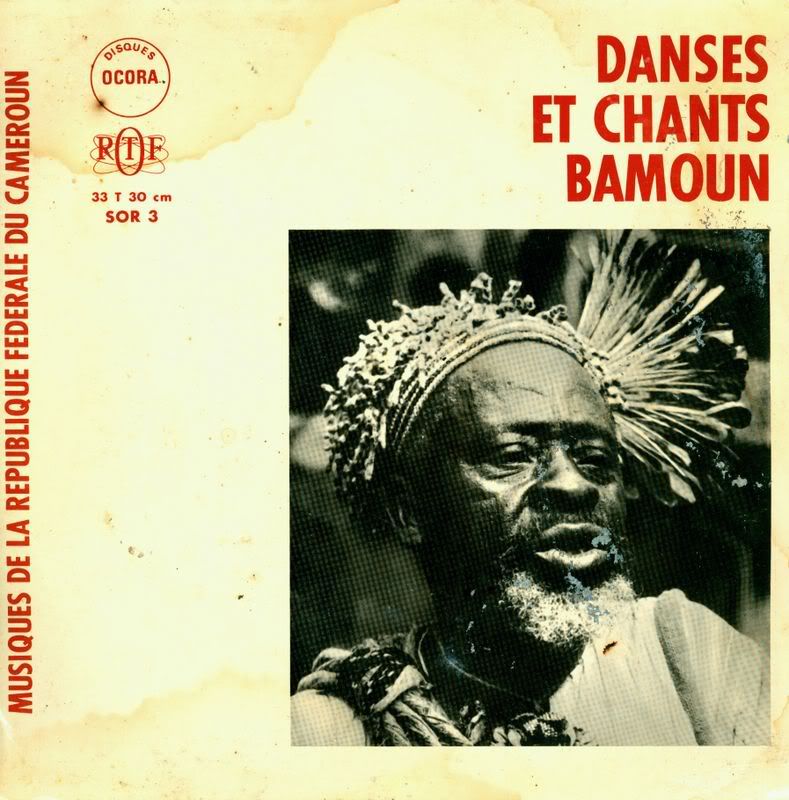
 Cameroun - Danses et Chants Bamoun: a very rare testimony of the traditional court music of Bamoun, warriors and landfarmers, and their life overseen by the Royal Family (Mbobo Sultan Seidou...), recorded by Michel Houdry in July 27th, 1957 at Foumban Palace.
 for me the musical treats on this old school Ocora record, never released on CD, start at track 3, where the grooves begin. (pseudo theory alert:) seems to me in a lot of traditional african music, Melody and Rhythm seem to have never been torn apart by divisive, compartmentalizing, and overly analytical minds, and remain, inseparably, perfectly, one (much like the modern Shangaan music in the previous post). some tracks suffer from out dated recording technology, and sound a bit muddy. this vinyl rip comes from the one they call Op.
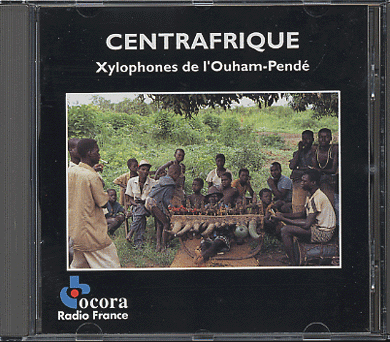 Centrafrique - Xylophones de l'Ouham-Pende:
"In Central African societies musical instruments have various functions linked to different musical repertories. First and foremost, instruments are used in ritual and initiation ceremonies, notably in connection with a heightened state of consciousness. The beating of musical instruments in particular, along with song, arouses that heightened state, which manifests itself in trance, auditory drive and/or music-colour synesthesia, allowing communication with the supernatural (often under the psychotropic influence of hallucinogens). Then there are such separate functions as sending messages from village to village by a slit-drum and providing entertainment for a group or an individual. The diversity of the functions of musical instruments is not, however, limited to these main contexts.
The instrument types found in Hornbostel and Sachs's classification of 1913–14 – idiophones, membranophones, chordophones and aerophones – are represented in Central African music. Notable among the wide distribution of instruments are the different kinds of xylophones, i.e. mentsiang of the Mpyemo (fig.3), kponingbo of the Zande (fig.4), zanga of the Pana and the Gbaya-Manza-Ngbaka, kalanga of the Banda-Mbiyi and kangba of the Manza, or the various forms of double-headed drums, i.e. ntumo of the Mpyemo, ndumo of the ‘pygmies’, kporo of the Banda Gbambiya, bio of the Gbaya and guru of the Zande."
in some ways a more straight forward enjoyable listen than the above, the pling-plong xylophones weave beautifully intricate rhythmelodies.
 Centrafrique Anthologies de La Musique Des Pygmees Aka: 2 CDs of field recordings of the Aka Pygmies, originally issued on LP in 1978, are presented here (sorry the tracks from 2 discs are mixed in one folder)
 "Music is part of daily life for the pygmies, as that's well illustrated here; every activity comes with singing, sometimes accompanied by varying forms of percussion, and some spare instrumentation, like the mo-beke, a kind of whistle, that features of "Nzombi." There are songs and music for activities, some with more sacred values, like "Mokondi," which is sung to dedicate a new camp. And there are song tales, songs of mourning, and for divination. There's some fascinating insight here, as well as some astonishing music. However, it's likely to be of interest to ethnomusicologists more than the general public, which is a shame, since there are beautiful melodies to be heard (great recording quality, too). ~ Chris Nickson, All Music Guide
The Aka are one of the three groups of Pygmies found in Central Africa today. They are monogamous and settle in small family encampments that comprise parents, children, sons, and daughters-in-law and offspring, groups of thirty to forty persons organized in democratic communities. Pygmy music, in the image of all their social activities, presents very similar characteristics, that is to say, relative autonomy of each participant within implied but strict structures. The recordings of this anthology, the first to be devoted to a single African people, offer in addition the distinctiveness of having been made in a single encampment, that of the old hunter Mbonzo, a group barely larger than forty persons. Music plays a central role among the Pygmies, there is no day without music."
 Central Africa. Aka Pygmies - Hunting, Love and Mockery Songs: another beautiful collection of the delicate and dreamlike songs of pygmies. on this one more accompanied by plucked string instruments than the marimba type sounds of the previous one. layered polyphonic voices glide over simple rhythm patterns, gentle, lovely and mesmerizing... i hope it gives you both enjoyment and inspiration.