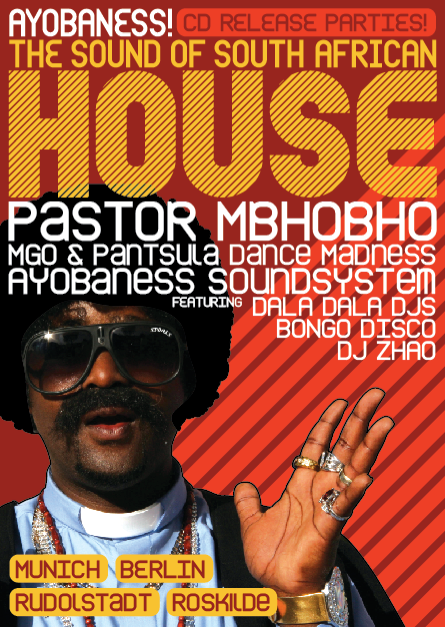
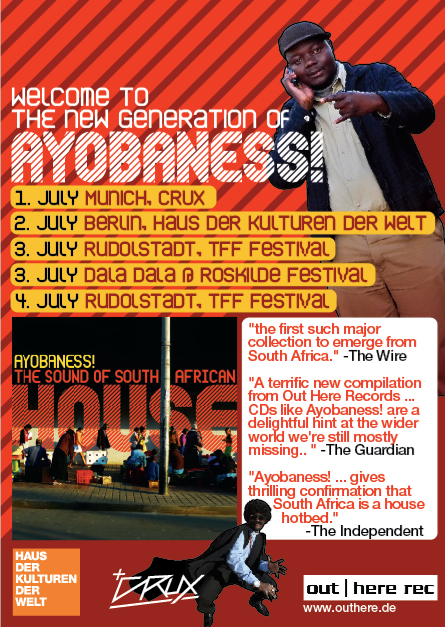
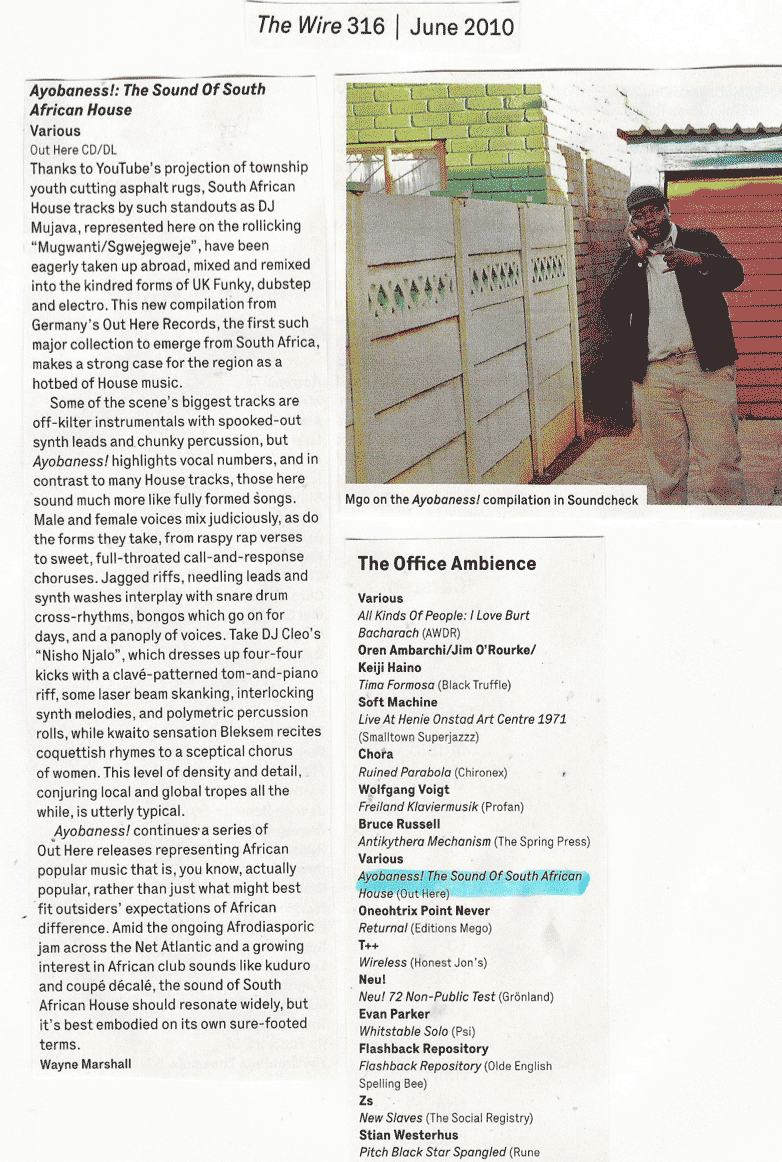
to celebrate Out Here records' release of Ayobaness: the Sound of South Afrian House, the first compilation of its kind in Europe (here is what The Wire said), SA superstars the Pastor, Mgo and dancers flew into Germany for a series of live shows, and i was lucky enough to be part of the one in Berlin. the space in Haus Der Kulturen Der Welt is very big and offical looking, so it was a little like dancing in a museum or the Reichstag, but the party popped off very nicely. AYOBAAAAAAAAAA-AYOBANESS!!!
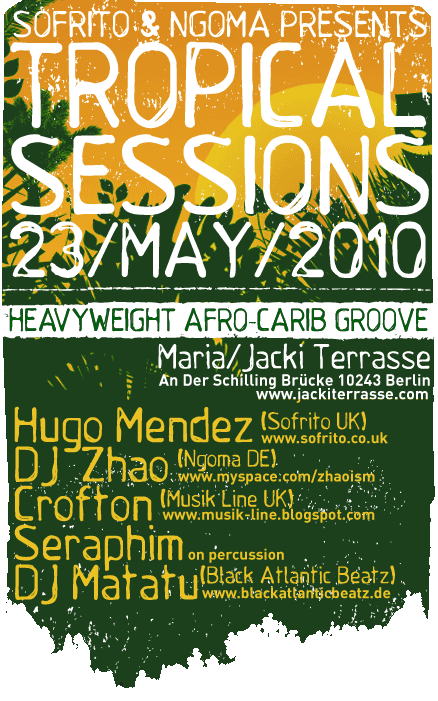
New sound for B-town: Hugo Mendez from legendary Sofrito (UK) and DJ Zhao of Ngoma Sound (DE) team up to bring the heaviest African, Caribbean, and South American rhythms, connecting the deep roots of modern club music with hard hitting contemporary urban flavors.
Simultaneously classic and urgent, sick and sweet, Tropical Sessions and guests brings you the timeless essence of groove: it is not "world music", it is simply the best dance music in the world.
Happening at the newly re-opend amazing Terrasse by the river, with sound equipped patio and grill action.
FIRST 50 PEOPLE BEFORE 10pm GET IN FREE after 10pm 12 Euro includes access to Maria - YAAM Birthday party (check www.clubmaria.de for details)
___________________________________________ Hugo Mendez' DJ style is a unique blend of African, Caribbean and Latin rhythms - a percussive explosion that includes heavy Afro grooves, old school mambo, Tropical Disco, bouncing samba, calypso funk and heavy Cumbia, bringing vintage styles up to date with exclusive dubplate edits and a contemporary club slant.
Hugo Mendez has put together several albums for leading record labels, including the genre-defining Tumbélé! compilation for Soundway Records and the highly successful Tropical Funk Experience album for Nascente. The albums come from digging trips across the Caribbean – scouring dusty warehouses and shacks for forgotten vinyl treasures and painstakingly tracking down artists and producers from back in the day. Hugo also produces the cult Rhythmagic Orchestra project with Nostalgia 77, and runs the Sofrito Specials label.
Prague Radio Set - a proper preview of what is to come in Fusion 2 and 3. no "cheesy" "ibiza" stuff here! lol
this one turned out pretty good, better than my sets at Herbst Radio Berlin, because there were several friends in the studio hanging out and bobbing along - amazing what a difference that makes. and the fact that i'm simply more used to playing on the radio now... so next time even alone i think it will be better.
track listing and a bit of text on this page, or you can go directly here, choose "Radio Wave" from drop down menu, and click 16.4.2010
what does it mean when someone says a piece of music is "cheesy"?
i think one of the common things is an adverse reaction to expressions of "genuine" feeling. I'm sure loads of kids think Louis Armstrong's sweet ballads are "cheesy". i don't, at all. when i hear his voice i feel it straight, without any irony what so ever. but there was a time i did. (though i do think Celion Dion is cheesy).
but why is genuine feeling ever considered cheesy? is it because substandard artists have cheapened it? too much indulgent, unreflexive, "fake" heart tugging, tear jerking; so that even when faced with "real" emotional content we think it's cheesy?
at times it has something to do with cultural age, like Louis Armstrong. or Marvyn Gaye or Bryan Ferry or Leonard Cohen, or, for that matter, Franz Schubert. so maybe a kind of expression i guess becomes so over used and loaded that many of the younger generations can no longer take it seriously. unless they really give it a chance, and "enter" the work; after which they see the substance and feel the power and are able to overcome the initial "cheesy" feeling -- i like Bryan Ferry now, but when my ex first played him for me i thought it was the cheesiest 80s shit ever.
Edward from Dissensus clarifies:
genuine emotion is never cheesy, fake emotion is always cheesy.
reality=lush, fakeness=pimping
minnie ripperton, a bit out of tune but so warm and human = not cheesy any pop r&b singer singing 24 different notes up n down around the melody because she has the ability to do it but not imparting any feeling= cheese
i think using obvious signifiers instead of trying to express YOURSELF is cheesy. so there are certain rock ballad chords that say "moody" but aren't really, certain techno sounds or snare fills that say "uplifting" but aren't really.... doing music by numbers, to a template, within a genre is cheesy.
originality, emotion, striving for self-expression: not cheesy
in addition to that, also something to do with personal age: seems that when i was younger i thought a lot of things were cheesy, like jazz as i mentioned. so as i get older, less things sound cheesy to me, and I'm able to appreciate more things on deeper levels. things like disco, R'n'B, Soca, Kizomba, are for sure in this category (but no not the horrible cheesy kind!)
also there are obviously cultural lines along with the Cheesy demarcation is constructed: 1 hour into my set at BOOMBX party last week, just got into some awesome sweet Hiplife (like this) after a few rather hard Electro-Kuduro hitters, this guy comes up to me and says: "can we move away from Ibiza and a little more toward Berlin please?" when i told him that this wasn't Hed Kandi, but Ghanian dancehall, he said "all this cheesy stuff sounds like Ibiza to me." ------ i guess all happy music is cheesy "Ibiza". and all cold, dark, monotony is "Berlin".
and someone called my South African House mixes cheesy in the comments a while back... i wonder if he thinks all club music is cheesy? or all feel good music is cheesy? or all non-angry/non-moody/non-"dark" music is cheesy?
i think more often than not, it is the person who cries "cheesy!" who has not given the work a chance on its own terms, enter its world, with its own logic. and it is only his/her own loss, naturally. it is really sad when people come to premature conclusions of a certain style of music based on exposure to only its cheapest or worst examples, which, admittedly, are both soul destroying and ubiquitous. for example cheesy Latin music and the cheesy "Latin Lover" archetype -- a lot of people in the west have robust prejudices when it comes to this music. it is sad when people close their minds so much, even if i can understand why - the amount of rubbish which they have been exposed to in the same style, that when faced with the real thing, they can not recognize it for what it is -- the most exquisite expression in the world:
i want to say to these people who write stuff off, who maintain ironic distances: forget your preconceptions, drop your prejudices, forget what you think you know, and give this new sound a chance. your life will only be richer for it.
(within limit, of course. no i am not going to give Celine Dion another chance, smartass.)
addendum:
and then there is the other side: the people whose ipods solely contain things like Hulk Hogan & His Wrestling Boot Band (real ipod owner, real band), which they would play for friends while laughing hysterically. there are the very popular parties in every major city across the world which only play 80s trash. it's an entire culture fixated by the "cheesy". irony for irony's sake. i think it's more than a sugar-high... something to do with The Uncanny? feels a bit necrophiliac... but i don't know enough about the scene to say what people get out of it exactly. if anyone has anything substantial to say about this i will post it below.
the badman from Singapore, my oldest friend on earth, Sufist drone architect, scribe of the apocalypse, the one and only Derek Wisdom, weighs in on the subject:
I've read a number of studies on kitsch in Gay American Culture that were quite interesting. Basically kitsch was used there historically as a means of re-purposing cultural detritus, to create a new language through inverting the oppressive values of american culture. This is a strategy typically employed by oppressed subcultures or cultures emerging against colonial rule, a means of collectively defining and then asserting themselves, a survival strategy. I'm sure some of that carries over into the pabst blue ribbon crowd but they obviously aren't oppressed. I think it's a mirror image actually, the Gay use of kitsch was to invert a value against an elite, whereas with "hipsters" (and I loathe to use that word, as it's most often used as a conversation stopping insult, but you know what I mean here) it's a technique used to assert themselves as an elite, the never ending series of name-droppings and irony contests.
I think there's an interesting territory here between cheez and kitsch, what can we laugh off and accept and even enjoy even if with heavy doses of irony and insincerity (which is still a form of social pleasure after all), and what just gives us the gas face? I think it's a social process, if we hear music we find cheesy when we are alone, we find it cheesy and reject it. It tends to only graduate to kitsch if it's experienced with other people if it gives us an avenue to assert our own social value via our allegedly clever sense of irony (and I'm making an unsaid distinction between music we find cheesy and later actually enjoy because of our tastes maturing as music listeners, and that which we accept explicitly as kitsch). One consistent use of Music in all cultures is as a means of creating and reinforcing cultural bonds. Back to the hulk hogan album example, I suspect if that music was heard in a vacuum, it wouldn't be interesting to the audience you mention. But as part of a social experience, it becomes valuable as a way to assert ones tastes and bid for status within that peer group. Hearing the same music alone, if one had no knowledge of a way to create such a social value or experience, one would then have to fall back on evaluating it's compositional values alone. The compositional factors though are actually bypassed in such a social group, instead what's focused on is the cultural apparatus, the fact it's music with lyrics by pro wrestling superstars about pro wrestling. Remove that apparatus and there's nothing of any interest to this social experience, as they aren't exactly sitting around examining the key changes and bpm of the songs in question. That's true of most pop culture though, very little of it makes sense to anyone who doesn't have fluency in the cultural signifier at use, and that can go both ways, it can be bewildering or it can also make it much more interesting and alien than it was in it's original context.
good article on the modern blackface that is FIFA's world cup song from Mahala blog. can't say i'm surprised -- another use for the paint metaphor: liberal progressive surface, racist structure.
people have brought up the fact that previous world cup songs have not always been representative of their host countries. while this is true, there are some differences:
this is a first for the African CONTINENT. a continent with an amazingly rich musical heritage (THE MOST amazing of all if you ask me, and a few musicologists).
Shakira is singing "waka waka" over an uncredited, unpaid-for rip-off of an old Cameroonian protest song.
Germany, Japan and France were colonialists, and have never been victims of colonialism, and they do not have a history of their music getting stolen and their artists being ripped off, because they were DOING the stealing and ripping off.
so given this context, this ABSOLUTELY should have been a chance for African voices to be heard, and African culture to take the spot light. but sadly, and expectedly, no.
in addition to the examples in the article, look into the history of The Lion Sleeps Tonight for a fascinating story. a documentary film has been made about this Zulu protest song from South Africa, whose lyrics mean "when the Europeans took over Africa, our king did not die, but only went to sleep, and will again wake someday" (a meaning all but entirely stripped from the words in the West). The Lion Sleeps Tonight has been a chart hit in America since the 1940s, covered many times by many different artists, and recently earned 15,000,000 USD in the Lion King alone -- but it's original author, living an impoverished life in the forbidden townships under apartheid rule, did not see a single penny until half a century later.